Vibration Reduction, Weight Optimization, and Energy Harvesting in Structures Using TMDI Systems
In this article, we examine inerter-based Tuned Mass Damper Inerter (TMDI) systems from an engineering perspective, focusing on: How vibration suppression performance is enhanced, How the need for additional mass is significantly reduced, The behavior of SDOF and MDOF structures under seismic effects, The potential for harvesting energy from vibrations, supported by formulations and engineering models.
Erkam V. Ballı
12/28/20154 min read
1. Introduction: Vibration Problem in Structures and the Classical Approach
Vibration control in structures subjected to dynamic effects such as earthquakes, wind, and traffic is one of the fundamental issues in performance-based structural design. Traditional seismic design philosophy is based on elastic behavior with controlled damage; however, modern engineering applications aim to reduce structural demands through passive vibration control systems.
Among these systems:
Seismic isolation,
Energy dissipators,
Tuned Mass Dampers (TMD)
are among the prominent solutions.
Mathematical Model of the Classical TMD;
2. Tuned Mass Damper (TMD): Advantages and Limitations
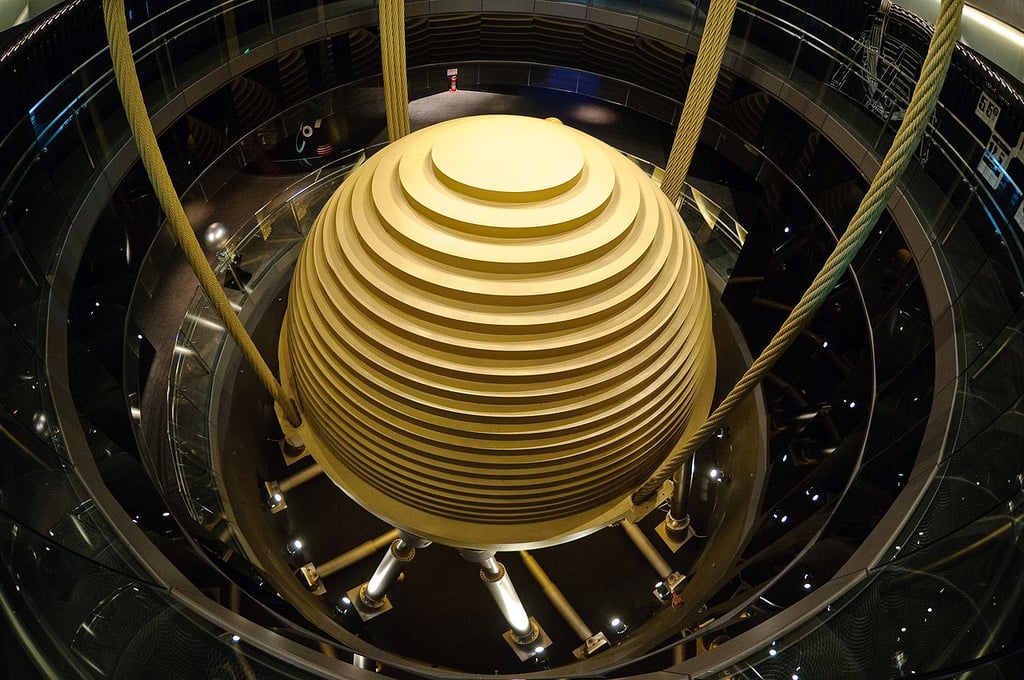
A TMD consists of an additional mass connected to the structure by a spring and a damper. When properly tuned, it can effectively suppress structural vibrations in the resonance region.
However, classical TMD systems have a fundamental disadvantage:
The vibration reduction performance is directly dependent on the magnitude of the added mass.
For example:
For wind and traffic effects, the TMD mass is typically 1–10% of the total structural mass.
For seismic effects, this ratio can increase to 25–100%.
This situation causes significant issues, especially in tall buildings, in terms of weight, placement, and cost.
3. The Concept of the Inerter and the Mass Amplification Effect
At this point, the inerter comes into play. An inerter is a mechanical element that produces a force proportional to the relative acceleration between its two terminals, both of which can move freely.
The critical feature of the inerter is:
Although its physical mass is small, it can dynamically create a very large “equivalent mass” effect.
This phenomenon is referred to in the literature as mass amplification, and it is expressed by the inerter coefficient “b.”
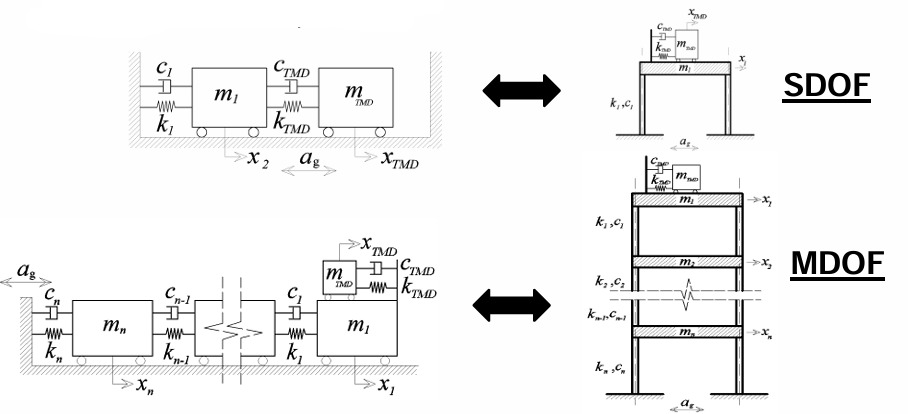
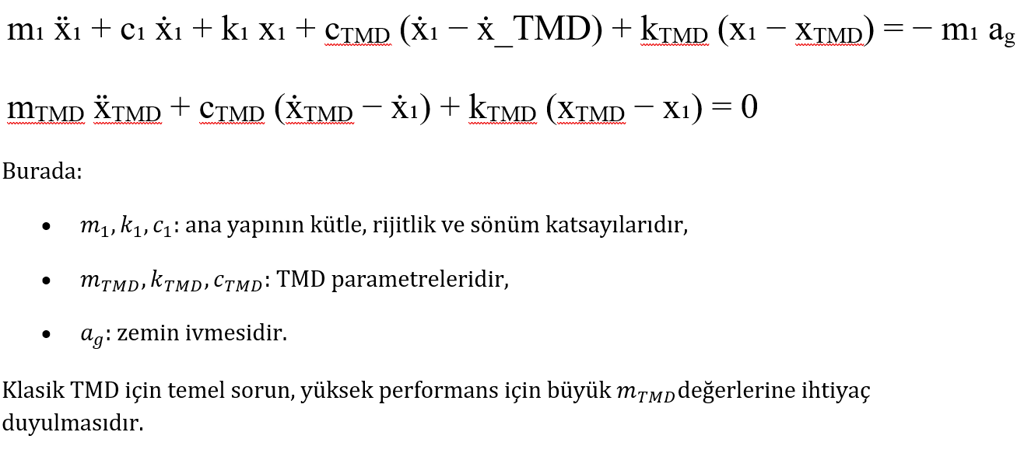
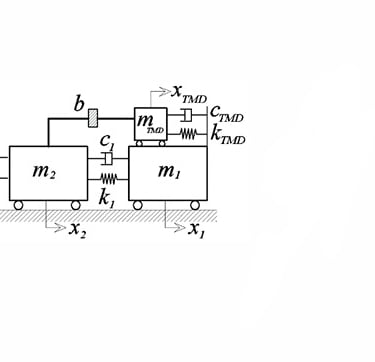
SDOF bir sistem için TMD ile donatılmış hareket denklemleri şu şekilde ifade edilebilir:
İnerter Kavramı ve Kütle Büyütme Etkisi:
İnerter, iki ucu serbest hareket edebilen ve uçları arasındaki bağıl ivmeye orantılı kuvvet üreten bir mekanik elemandır:
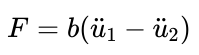
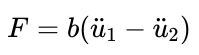
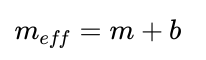
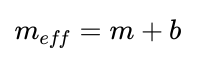
Burada b inerter katsayısıdır ve birimi kütledir. İnerter sayesinde sistemin etkin kütlesi şu şekilde artar:
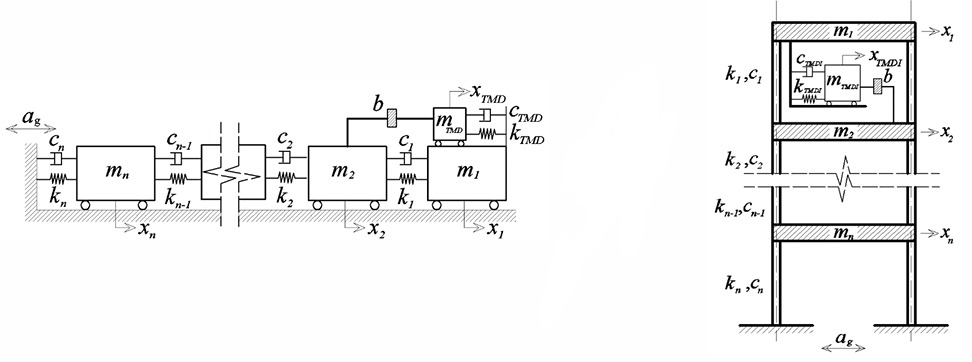
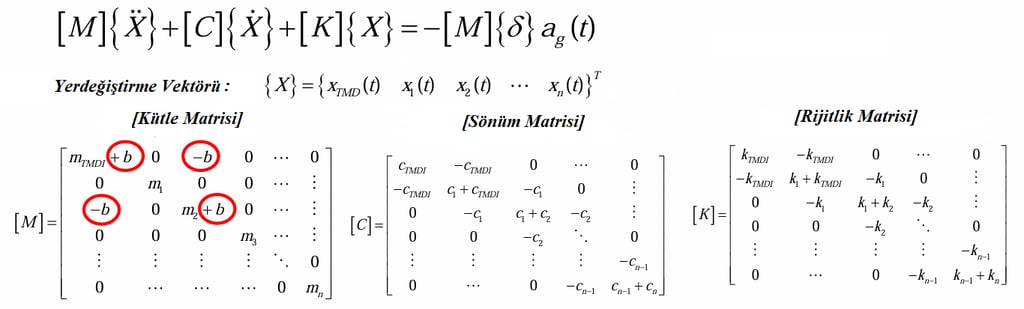
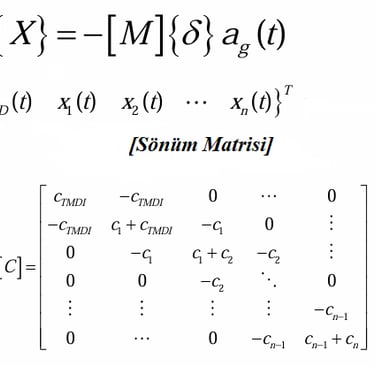
For an MDOF system equipped with a TMD, the equations of motion can be expressed as follows:
4. TMDI: Tuned Mass Damper – Inerter System
TMDI (Tuned Mass Damper Inerter) is a new-generation passive vibration control system obtained by adding an inerter to the classical TMD system.
Key features of TMDI systems:
They are a generalized form of the classical TMD.
Existing TMD tuning methods can be applied.
The same level of vibration reduction can be achieved with a much smaller physical mass.
This feature makes TMDI particularly attractive from an earthquake engineering perspective.
5. TMDI Performance in Single Degree of Freedom (SDOF) Systems
Analytical results obtained under harmonic or white-noise base excitation show:
When an inerter is added, the displacement response at the natural frequency of the structure decreases significantly.
For the same mass ratio, TMDI produces a lower maximum response compared to classical TMD.
The system becomes more robust against tuning errors (detuning).
Increasing inerter values improve performance up to a certain point, after which the improvement saturates.
Example comparison:
A classical TMD requires a mass ratio of μ = 0.63.
With TMDI, the same performance can be achieved with a mass ratio of μ = 0.34.
6. Multi-Degree-of-Freedom (MDOF) Structures and Seismic Effects
In multi-story structures, TMDI can be modeled as an interstory coupling element. Optimization studies conducted under stochastic, time-dependent earthquake records yield the following results:
TMDI reduces upper-story displacements more effectively than classical TMD.
For the same performance level, the required additional mass is significantly reduced.
For example, for a certain performance target:
Classical TMD: requires 31 tons of added mass.
TMDI: requires only 6 tons of added mass.
This difference is a game-changer for practical engineering applications.
7. Energy Harvesting Capability: Electricity Generation from Vibration
When TMDI systems are integrated with an electromagnetic or piezoelectric generator, energy harvesting becomes possible. In this case, the system:
Reduces structural vibrations,
Simultaneously generates electrical energy.
However, an important engineering reality emerges:
A system optimized for vibration suppression is not optimal for energy harvesting.
As the inerter ratio increases:
Vibration suppression improves,
But the harvestable energy decreases because the relative velocity is reduced.
Therefore, TMDI offers a tunable balance between vibration control and energy harvesting.
8. Conclusions and Engineering Assessment
TMDI systems are passive vibration control solutions that outperform classical TMDs. With their lower physical mass requirement, higher efficiency, and energy harvesting potential, they represent a promising engineering solution—especially for tall buildings, bridges, wind turbines, and offshore structures.